Won’t be eating here … not for a while.

This restaurant is next to the barber shop I patronize here in Pune. I haven’t mustered the courage to examine the menu.
This restaurant is next to the barber shop I patronize here in Pune. I haven’t mustered the courage to examine the menu.

No, Kim is not scrutinizing the posture of a literally statuesque Hindu dancer. She is instead looking up at this unexpected feature of the Karla Caves, namely, beehives:

Yesterday we decided to do some sight seeing and the Karla Caves seemed like a good destination. Since reading about the rock-cut architecture of India I have wanted to visit one of these caves. Karla, at 50 kms or so away, is a convenient destination, so we set out early and arrived at 10:30 am or so.
Before saying more about the actual caves, for the benefit of fellow visiting foreigners let me say a bit about guides, helpers and touts. India is fraught with such characters and tourist destinations especially so. As soon as an obvious bunch of Westerners arrive you will be accosted by “guides” who offer to help you with local knowledge. Their usefulness is marginal, but by knowing the details of these places they can save you a bit of aimless wandering. For me the main appeal of these fellows are the ridiculous prices they will ask and the opportunity for bargaining. At these times, if you want the help of a guide, be prepared for something like this:
“Sir! I am expert on the caves! I show everything, only 700 rupees.”
“700? For that price I expect you to carry me up to the temple.”
“Sir?”
“700 is too much. How about 50?”
“Sir! With all my knowledge? For you I give special price, 500 only …”
And so it goes. The amounts really don’t matter to Westerners. But there are many hard-working Indians who are lucky to make Rs. 500 (or less) in a 12-hour day of actual labor. For that reason I’m loathe to give the same amount to some fast-talker who will spend 30 mins telling me stuff I already know from my wikiPedia reading. Yesterday after a few minutes of haggling I engaged a man for Rs. 200. Ultimately he didn’t have any special insights to impart, but it helped the local economy I suppose.
On to the caves. Karla is at the top of hill. You go most of the way by car, but then there is a winding path of steps that takes you the remaining few hundreds of meters to the top:

The way up is lined with stalls like these:

Many of these sell refreshments and souvenirs, but a great many sell marigolds, spices, coconuts – the necessary materials for a puja that Hindus will perform at the temple at the top of the hill.
Karla is a very old place, dating from the 2nd century BC. Here is the outside of the caves:

The upper galleries you see are closed off from visitors. Anyway 2,000 years ago this space in front of the caves was a village-like affair, a stopping point on the Buddhist trade-routes that criss-crossed ancient India.
There are 2 main features of the caves, the first being the prayer hall:

At the far end is the stupa, a dome-like stone housing relics and adorned with inscriptions. This hall magnifies sound; the favorite activity of the many school children visiting was to shout slogans and hear them echo. Again, it was intriguing to imagine 2,000 years ago, the hall full of seated monks and their prayers reverberating.
The second feature are the smaller caves with meditation cells for individual monks:

These spaces inside are only a few feet across. Seated in such a place I can see how there would be little distraction – assuming one could get over the distraction of sitting, that is.
Hearing of these cave-cells I jokingly asked our “guide” if I could see Bodhidharma’s shadow in this place. The guide replied that indeed many Chinese people visited these caves. Sigh.
Between the prayer-hall and the meditation cells it’s rather amazing to consider these vast spaces were mainly cut by hand out of solid stone. As I read here, the main technique used was to create small crevices in the stone, push in dry wood, then apply water – the expansion of wet wood fractures the stone.
In the centuries since its founding Karla has become more of a Hindu destination than a Buddhist one. Outside the prayer-hall is a small temple to Ekveera, a goddess revered by Koli people who live mainly in Mumbai. We all went inside and while we could take no photos, for Rs. 40 we all received a ceremonial dab of red dye on our foreheads together with, presumably, the goddess’ blessing.
Finally it was time to go, but not before obtaining a souvenir of our visit. At the bottom of the path was a man selling minerals. I selected these 2 pieces:

Minerals seem an appropriate keepsake for visiting a cave. The piece on the right is calcite, perhaps two pounds in weight. On the left is what I think is an apophyllite, a common crystal found in Maharashtra.
Once again it was time for bargaining. The shopman started at Rs. 2,500 – “These minerals come from this very mountain!” he confidently declared. I was very happy to see his consternation when I suggested 400. I walked away from the booth two times – in one of those cases remarking “I had plenty of rocks back in the US” – only to return to hear more offers. Walking away the 3rd time the shopman came after holding the minerals and we agreed on Rs. 600. As is usual in these cases you have no idea how well you really did – he probably got these pieces for 5 or 10 – but the experience is half the fun.
All in all, a very engaging visit. We’d very much like to go on a longer trip to a place like Ajanta Caves, one of the foremost cave temples in India.

This helpful sign we saw at Rajiv Gandhi Zoological Park, here in Pune. Based on the detailed description, we all assumed that perturbing, enticing, needling, nagging, riling and rankling probably would be Ok.
Of course, when the representative animals are like this:

it is probably best to leave sleeping snakes lie un-rankled, as it were.

Last weekend I went to do some shopping on MG Road. (Mahatma Gandhi Road, virtually all cities in India have one.) In Pune MG Road is a great place for shopping; if it’s physically for sale in the city, you can find it there.
A cute knick-knack sort of thing I saw:

A musical Lord Ganesha, with mouse accompanists. (Like Lord Shiva rides a bull, Lord Ganesha rides a mouse.)
Shops you’ll find on MG Road range from typical Western brands – Adidas, Nike, Levi’s and the like – to a much greater range of Indian shops. There’s also places like The Bombay Store, that carry Indian goods but cater to tourists or higher-income Indians.
Something that will seem odd to Westerners – certainly was odd to me – is this:

Notice how there are two shoe stores right next to each other? This is kind of like having an Athlete’s Foot next to a Footlocker in the US. Why open next to your competitor and give buyers the opportunity to easily comparison shop? Apparently the logic in India is people won’t bother to make the trip to a place where there is only a single vendor – competition right next door is implicit proof this is a going commercial concern.
I saw a lot of things on MG Road. I really wanted to just get a sense of what was there, though I did have one idea for buying, namely: Simple things I could bring back to US as presents. India is famous for textiles, so I thought maybe scarves or simple kameez would make good gifts. Another thing on my mind was shirts. I have read several times that garments can easily be custom-made here – one place I read this was in IBM-colleague Bob Carlsen’s book Sacred Dust on Crowded Streets. That was on my mind as well.
As it happened I found myself in this tiny place:

Like many Indian shops it is very narrow – 2, 2 1/2 meters side to side – but very deep, stretching back 20 meters or more. This was a cloth store and the shop-man, a Mr. Gobinda, was very excited to show me all he had. It now occurred to me that kameez was too ambitious of a goal – all the female recipients I could think of would very much prefer to take their own choices rather than mine – but scarves seemed a doable thing.
And there were a lot. Here are some I ended up with:

These are sheer silk, all with paisley patterns. I also obtained some shawls, like this one:

These shawls are made of a fine wool thread; the company that makes them is named Oswal; I got 5 different color combinations.
Thinking of shirts I inquired of Mr. Gobinda. To no one’s surprise, shirts could be had. Excellent shirts, the very best. Made precisely for you. Our shirts are famous, famous I tell you. Observe this cloth, sir, please feel it. What, the color does not please you? I remove it, I discard it, I send it far away. Perhaps these other colors? And trousers, sir … ?
Excuse me, I digress. 40 minutes, several cups of tea, and one short stroll to the tailor shop later, I had arranged for 3 Western-style business shirts, of 3 colors in simple cotton, and 2 kurta-style shirts, in coarse red and brown silk. The results you see at the top photo.
The cost of all this?
• 10 silk scarves, each 21” x 72” (plus 1 “for free”): Rs. 1000 ($19).
• 5 fine wool shawls, each 38” x 82”: Rs. 2,000 ($38).
• Fabric for 5 shirts, 3 cotton (blue, cream & white), 2 silk (red & brown): Rs. 3,100. ($58.50)
• Sewing of 5 shirts, 2 kurta-style with simple collars, 3 Western style with business collar and cuffs: Rs. 1,000 ($19).
As I recall the cotton was about Rs. 200 or 250 per meter; because I had long-sleeved shirts I believe 3.5 meters were needed per shirt. The silk was more, ~ Rs. 300 a meter, I can’t recall exactly, but I needed less because of short-sleeves. Off top of my head I have no direct reference points for buying fabric. But I buy shirts from Land’s End, LL Bean, etc. all the time. There a single shirt is at least $30 – let alone 5.
Finally … tailoring for 5 hand-sewn shirts, for $20? It boggles the Western mind, until you do the math from an Indian perspective. The tailor has made a great many shirts before, so he knows what he is doing. As a guess, maybe it took him 2 full days to make my 5 shirts. If he is able to work at this level 30 days out of each month, he makes Rs. 15,000 per month, as much as a driver or many other average Indian people. And if because of his skill and experience, it only took him 1 day in all, then his earnings would be Rs. 30,000 a month, even better still.
I’ll let people draw their own economic conclusions. I’m still thinking of all the scarves and shawls, the tiny 8” x 8” tailor shop, Mr. Gobinda’s cheerful mercantilism, and the straight-line stitching on my new shirt-collars.

Ok, perhaps ‘karmic’ remains to be seen. The important thing is, here in India I have bought my own car. Arre Kya Baat Hai!*
Up until now I have been renting a car. Renting or leasing a vehicle is different here than in the US. What you rent is a car and a driver who will take you wherever you need to go; the cost per day is Rs. 1,700 – 2,000 ($32 – 38). This is convenient and for short-term business trips perfectly fine. However as a long-time New Englander I have an impulse to economize. Also the basic car you get when you rent is a compact, like the Maruti Swift or Tata Indigo. When Kim, Alex and Morgan are here, all arriving with lots of luggage for extended stays, these little vehicles won’t cut it.
The car you want here for carrying lots of people and luggage in comfort is the Toyota Innova. This is a mini-van not that different from the Toyota Sienna we had a few years back. There’s at least 4 Innovas parked in the garages at my flat and you see them all over as you drive around. Having ridden in one a few times I concluded it was the car for me. Here’s a better look at my actual car, parked at my flat:
 A popular car site here is carewale.com (Hindi for “car merchant”). There I was able to research prices and features, and also re-sale value for used Innovas. Another variable in my cost analysis was salaries for drivers. For that I learned a lot from my colleagues at work, and also there are examples you can find on sites like indiamike.com. Then there’s the price of fuel. Petrol here is Rs. 75 per liter, or about $5.40 per gallon; diesel is government subsidized and is Rs. 49 per liter, or about $3.50 per gallon. Most vehicles here use diesel. With all these facts I figured that by buying now and selling when I leave India, even with paying a driver and buying fuel I should break even (or even do better) relative to renting a compact car – and I’d have a much better vehicle.
But, how to get it? I didn’t want to buy a used vehicle from a private person, because I wanted to make sure all the needed registrations would be done properly. I was also confused a bit by something I read in an expat guide, which said foreigners could only own a vehicle after 1 year of residence. That was not true, as I found out when I visited a dealer, DSK Toyota and its showroom in Hadapsar. The folks there explained there were no problems and so that’s where I made my purchase. DSK handled all the paperwork and registrations on my behalf – could not have been easier.
Finally the car is ready for you to take delivery, but one thing remains – the puja, which you see in the photo at top. Puja refers to a variety of rituals made by Hindus, and some Buddhists. There are many different ways this can be done, but the constant principle is to make an offering to a god and ask their blessing. Some Hindus make puja everyday, but starting a new venture, like opening a business or buying a car are special times that virtually always require puja; for the average Indian person if there was no puja for a new car they would be uncomfortable. (Which reminds me I have to ask some friends how they feel when they travel overseas and ride in cars in the US or elsewhere.)
Here’s the preparation for the puja, including water, incense, spices, rice and turmeric/sandalwood paste, and coconut:
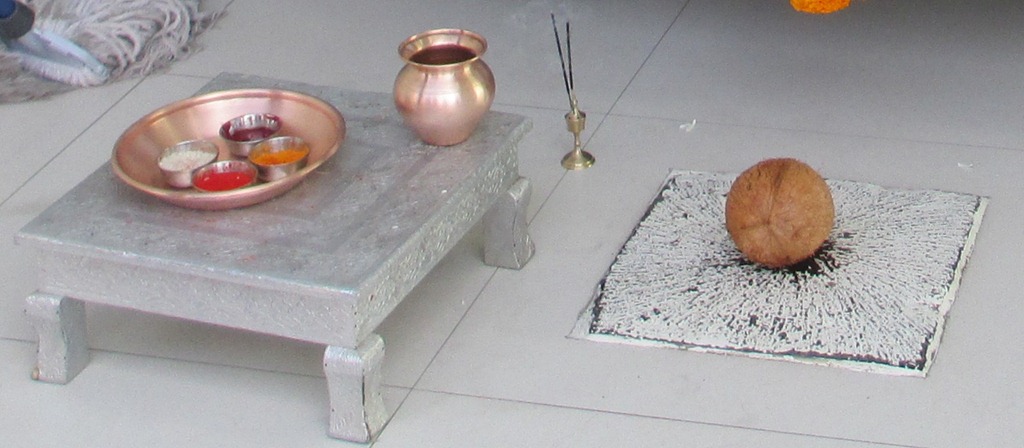
In summary, the puja for my Innova was to Lord Ganesh (who blesses new ventures) and went like so: First came the decoration of ribbon and marigolds. I then donned the hat you see in the photo. (In the middle and North of India people cover their heads when doing puja, in the South apparently they don’t.) Then my helper – also wearing a hat – inscribed a swastika on the front of the hood with red paste – swastika is an ancient sanskrit word, and in that context roughly means “goodness” or “higher self”. Next we circled the car clockwise, sprinkling each tire with water. After that we went round again, this time daubing each tire with saffron power, turmeric and then sprinkling rice. All the while incense was burning. Then we came to my favorite part. I was handed a coconut, told to make a few mystic passes with it, and then to smash it in the pad provided. Roger that! Coconut water not only anointed the car like it was supposed to, but all the onlookers as well. Finally we put saffron and turmeric on the small glass Ganesh that the dealer provided, and made an offering of some of the coconut and a piece of peda:

Peda is a kind of sweet made with milk and sugar, and flavored with pistachio, saffron or other spices. We shared out some peda with folks from the dealership, moved the Ganesh to inside on the dashboard, and our puja was done. The coda to the ritual was to provide a few small tips to my sales associate and to my puja helpers.
I’ve been driving in the car – with my driver Rupesh, of course – since Tuesday last and a finer ride can’t be found. Based on wife Kim’s suggestion I call the car “Coconut” – we, like many US folks, have the habit of naming our cars so there’s no reason not to name this one. Rupesh approves – the coconut after all is sweet, sustaining, and – aside from my smashing example – quite sturdy, all useful attributes in a car.
My Western friends may be thinking – not to put too fine a point – that this primitive religiosity is at best quaint, but more likely a hindrance to modern development. In one sense I agree – India is in many ways a medieval place. But I also am in mind of a remark made by the hero in Zelazny’s Hugo-winning Lord of Light, who said:
This is only one world … who knows what goes on elsewhere?
While I’m here in this world – India – I’m happy to let its ways guide me. And as my family knows I’ve more than once made my own small rituals to commemorate a passing friend or the end of the year – puja is no different.
Till next time … thanks for reading.
* Literally means “Hey, what’s up?”, but as an interjection can mean “Hey, great!” or “How wonderful!”
I recently received a mail from a friend referencing this image:

Diwali being the Festival of Lights, in a simple way the caption makes sense.
Except this has nothing to do with Diwali. As described here, this photo was indeed made by NASA, but it is a composite of satellite images taken over several years. The purpose is to show the growth of India from 1992 to 2003. White light in the photo indicates light-sources visible before 1992; blue are lights that became visible in 1992; green lights became visible from 1993 to 1998; and red lights became visible between 1999 and 2003.
Among the things you see in this composite is the development of Madhya Pradesh (still one of the poorer Indian states) in the late 90s, and sparser, recent development in the wilderness areas of Orissa and West Bengal.
The original NASA photos: Nighttime Lights Of India
BTW, here’s where I am:


Today is the official starting day of Diwali, the Indian Festival of Lights. I say Indian because Diwali, while ostensibly a Hindu festival, nonetheless attracts all faiths to its activities of feasting, family-visiting, gift-giving and – as you see above – fireworks. These are just some examples I was able to capture snapping pix from my balcony. As I type and look out my office window I see fireworks near and far almost continuously. Firecrackers – some incredibly loud – have been echoing all around since dawn this morning. Fireworks of various types have been going off since Saturday, though tonight seems to be the most so far.

I found these used examples outside my flat this morning, a rather heavy roman-candle like thing and an empty box of sparklers. I guess Batman is somehow a cross-cultural symbol of night – on my balcony this evening I certainly saw enough actual bats.
Diwali is also a time to show appreciation to employees. I have made a modest tip to the security people at my building, and I hope to do the same later this week for my driver. The local newspapers feature many stories on public employees and the bonuses they do or do not receive for this holiday.
Ah – a barrage of screamers is zinging past my windows now. Happy Diwali, everyone!

Today I took a bit of a walk – 3 kms out and 3 kms back – to look around near where I live. To the west of me is Koregaon Park, somewhere I know pretty well now, an upscale area (for Pune) of restaurants and shops. Today I headed east to see what I could see.
There was no shortage of livestock out today. Here a young man was leading a herd of goats. Goat-meat here is called mutton; in US, UK and most western countries we take mutton to be sheep or older lamb.

I saw many buffalos as well, like this large specimen browsing at some trash:

These animals just burst out into traffic, I had to scramble to get a shot as they galloped by:

(Where they ran out of was the access road to the Hard Rock Café. Perhaps they know something about the culinary practices there that we don’t?)
This station was setup on an empty stretch of the road, apparently a service provided by the government:

An impressive list of ailments, to be sure. None of the locals seemed to be interested, however.
I passed a playground, with kids playing, and older women in saris sitting by and watching:

A more common sight is this, where kids in humbler surroundings play with whatever is to hand: stones, sticks, an old tire:

About half-way out on my jaunt I saw this lady:

I expect she was coming from the market, which I reached just a bit further on:

There were many fruits and vegetables here, and doubtless more workaday goods in the lanes and stalls further back.
Anyone who comes here will quickly get used to billboards like this:

I have to say I find the juxtaposition of these fantasies of luxury with the day to day reality of corrugated metal lean-tos and goats in the backyard to be more than a little jarring. I’ll have to do a post dedicated to this; like the sentiment above, “Only the attitude is real”, these Indian ads intensely emphasize pampering yourself, that you deserve luxury, and that indulgence is good.
I’ll close with another ad I saw, one a bit more practical:

Now that is real.

This week saw me on a work trip to Seoul, S. Korea. The work part was very productive, but the highlight was the hospitality, including dining on Korean barbeque. Above is a long table of various IBM colleagues. The silver tubes are chimneys that take away the smoke of the barbeque.
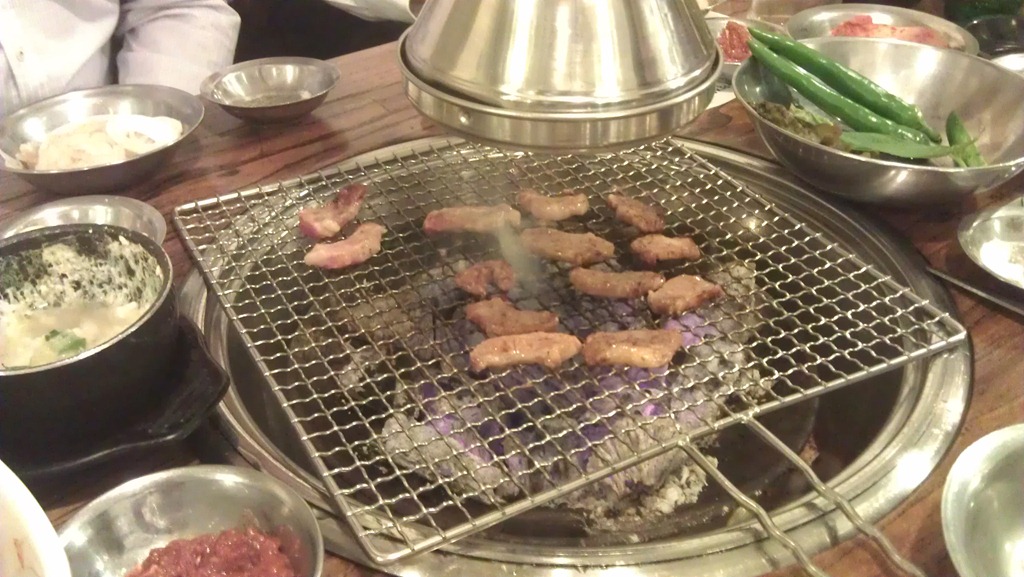
Here’s a close-up look. What’s grilling here is pork cheeks. The fire is actual charcoal that when brought to your table is bright cherry-red with heat. When the morsels get to the desired level of crispiness, you grab 1 or 2 with chopsticks, dab with salt, wrap in a lettuce leaf or a perilla leaf, maybe add some spicy bean paste, then munch away. Other accompaniments: braised sweet potato, similar to this recipe; gyeran jjim, a steamed egg custard kind of like Japanese chawanmushi; and of course several kinds of kimchii.
And lest I forget, all is washed down with liberal amounts of beer and soju, the rice wine of Korea.
So as much as I’m enjoying the cuisine of my adopted home, India, this trip was much welcomed by my carnivorous side. I’m hopeful I’ll be back before too many months go by.

Out doing some errands yesterday saw these cows – or buffalo, actually. I came upon several other small herds walking the streets, one quite close to IBM buildings in downtown Pune.
Folks from US ask me this all the time – “Are there really cows walking around all over?” Yes there are, but in the city at least they are not free-ranging. They have caretakers who look after them, is the best I can say. A common sight in the outer districts is a cow or cows browsing through trash piles for scraps. Also there is a difference between cows, which are mostly white, and buffalos like those above which are black or dark brown. The cows are the most sacred beasts, while buffalos are working animals.
I don’t yet understand everything going on here, but a few searches will show you there is considerable conflict centered on the cow, as seen in this example article.