Week before I received an invitation from an expat group I belong to, Everything Expats. Everything Expats provides relocation services for expatriates and as part of that they also maintain a mailing list, host a forum where expats can trade info, and from time to time host get-togethers where foreigners can meet both other foreigners and local folks as well. The invite was for the running of the Theur Hamlet Cup at Pune Racecourse on Sunday 4 August. Seemed intriguing, so off we went.
The day was overcast – the monsoon is not quite done – and we had light mists of rain all through the afternoon. Here’s a view of part of the Member’s Area and the public grandstand beyond:
Like many things here, the racecourse has an old-timey feel – one could easily picture Nicely-Nicely Johnson, Harry the Horse, or any other of Damon Runyon’s characters placing a bet at the tote window. Horse racing has been happening in Pune since at least 1815. In 1870 a Major General Burnett donated the current race course lands to the West India Turf Club; the race course is in the middle of the Pune Cantonment, a military district established by the British in 1817 and today maintained by the Indian Army.
Nowadays the race course is part of both the Pune social and commercial scene. The “Theur Hamlet Cup” was sponsored by a local real-estate developer, Theur, who was promoting a new development, “The Hamlet”. Far from Elsinore in both distance and conception, The Hamlet features horseback riding and also high-end bungalows with solar panels and other eco-minded features. But the real-estate angle hardly impinged on us, mostly we wandered about, mingled and generally had a nice afternoon:
This is a turf club with real turf. After each race a crew would slowly pace the grass of the track, fixing up the divots made by the race horses:
We all noticed that it was the women who did all the fixing; the men just trudged after dragging their rakes and talking.
What was the financial upshot of all this? Well, despite losing Rs. 100 on the first race I bet – on a long-shot named Salsa – we had a winner and a placer on the two next races, greys picked by Morgan and Kim named Four-Star General and Hachiko respectively. In the actual Theur Cup race, Mars was the favorite and Fortune Favors the #2. Hoping boldness would be rewarded, I put another Rs. 100 on Fortune Favors to win, but it was not to be. If not for that last bet I would have been up a big, big Rs. 30 (about $0.50).
I should have used a more scientific method, like these guys:
I was in Mumbai on Friday, presenting at an event for customers. After staying the night, I drove back home, leaving a bit before 9 and arriving back home in Pune a bit after 1. Traffic was very heavy, and the trip took an hour longer than the usual 3 – 3.5 hours.
One reason is the Mumbai streets, an example you see above. I was in Chennai for a short time day before and something that instantly struck me was the streets there – all smooth concrete. Admittedly I didn’t see much of the city – only went from airport to hotel and back – but still the contrast was striking. The Chennai streets were smooth riding and allowed slow but continuous speeds. Mumbai streets … well, you may get up to 30 kph for 15 seconds or so, then you hit a rough patch so you slow down, then you try to accelerate and then you hit – guess what? – a speed bump. Anyway, Mumbai may be the richest city in India, but its roads are terrible.
I guess it is no wonder the roads are made with brick. Brick-making is ancient in India. Doubtless when the Israelites were making bricks in Egypt, so too were the Aryans and other races making them here. In my car-travels I have seen many brickworks, like this one:
Looks to me methods in India today are not all that different from the Israelites’ time: Mold bricks from sand, mud and straw, stack them in a big pile, then build a fire underneath and let the whole thing heat up. The resulting bricks look like this:
These particular bricks are piled up outside the car-park at my flat, to be used in some new walkways. These bricks are more baked than fired; I easily scratched deep into one with my fingernail.
Sadly, there are other parallels here with the Israelites of Moses’ time: Many workers at these brickworks are slaves, working to pay off supposed debts incurred by their parents, grandparents, or even earlier antecedents.
While some streets, or parts of streets, in Mumbai (Pune as well) are concrete and asphalt, 90% are this mix of brick, concrete paver, poured concrete, and dry, crumbly asphalt. As you drive around you can’t help having an archeologist’s attitude, as you see erosion exposing layer upon layer and the attempts of different construction methods. For the most part brick does not make for even roadways. Even on the best of footings individual bricks settle differently from those nearby … and the footings here are anything but the best, even for roads bricks are set on dirt. One good sluicing monsoon rain and it is a surprise these roads don’t wash away.
Uttarakhand is to the north and east of New Delhi. Here many rivers flow, with sources in the Himalayas, down through Uttarakhand, then through Uttar Pradesh, finally reaching Kolkatta and the Bay of Bengal. The Ganges, sacred to Hindus, is one such river. This time of year brings many pilgrims to Uttarakhand. The Ganges Basin is one of the oldest settled regions on Earth, and near to the river are many places dedicated to Lords Shiva, Vishnu and Krishna. One of the oldest is Haridwar, 200 kms from New Delhi and just where the river emerges from the high barrier of the Ranipur Range. Haridwar is one of the places where the celestial bird Garuda dropped the elixir of immortality. To bathe in the Ganges here is an experience sought by all devout Hindus.
The ingredients of this tragedy are not hard to perceive. Many things are built quickly here. Tea stalls, shops, and even “hotels” – modest hostels – can appear overnight, which when pilgrims come in large numbers, is exactly what happens. The pilgrims come for the river, so things are built near the river, then a flood comes … all the sadder because of the predictability.
Back to my drive from Mumbai, the going was so slow I had ample time just to look at scenes and at people. It was early in the day yet and while people were on the way to their jobs, work for the most part had not begun. Here some road-repair was in progress:
No workmen were in evidence; they may have left their patching from the night before.
My way through Mumbai took me underneath the elevated metro being constructed here. One of the planned lines goes to the airport, which my hotel was near. The scenes of this part of the trip were not the best, many places resting up against the giant concrete pylons were piles of festering trash. Looking up through the car windows at the 20 meters or more elevation of the railway, I had to wonder what it will be like, when train riders whisk back and forth to the airport, while below slumdwellers eke out a living in their shadow.
This is not all bad for these groundlings. Some actual “slumdogs” living in this area are becoming real millionaires, by selling the hovels they purchased before the airport came into being. One man bought two hovels 50 years ago for Rs. 40; going by average rates back to the 70s, that was about $1.50. He now is selling these for Rs 1.4 crore (14,000,000 rupees), or nearly $250,000. Such is the value of real estate close to the airport in this wealthy city.
Construction like the metro is everywhere here. Another thing impeding my progress home was road construction, like this:
This pic, snapped through the car window, shows the steel skeleton of a flyover support. Flyovers are very common here, they elevate the roadway so a crossing way can pass underneath without impeding the main flow of traffic.
Most major structures here are made like this: A steel skeleton is built, concrete forms are constructed around the skeleton, then the forms are filled with concrete. Judging from what I see around me this is the easy part; the metro areas of Pune and Mumbai are dotted with the concrete frames of flyovers, apartment blocks, tech centers and more. Anyway, with India growing so quickly, it is no wonder some of the big fortunes here have been built on steel and concrete. India is the world’s #4 steel producer and its steel industry is the fastest growing in the world. India is the #2 cement producer, after China.
On the road to Pune I had another experience with steel. Not quite on the main highway, we were on a major road where traffic should have been making 50 kph or so. Instead we were stuck, inching forward. After a few minutes we encountered part of the explanation – a dog, one of millions of feral dogs that live here, dead on the pavement, its neck askew.
10 or 15 meters further on we saw a large bus, a “luxury coach” as they are called here, stopped at the side of the road. Coming abreast of it I saw its windshield and part of its front was caved in.
Then the story became clear. Just ahead of the bus was a Maruti WagonR, a kind of small minivan. It was crushed, accordioned to half its normal length. Apparently the WagonR had hit the dog, slammed on its brakes, and the bus smashed it from behind. People milled about, talking on cellphones. No ambulances were in evidence so I believe – and hope – there was no major injury.
At least we reached the highway and had swift driving the remaining 110 kms or so to Pune. The day was fine and I saw more evidence of the rains in the many small waterfalls running down the hillsides, like these I snapped in the distance:
There were many clear flowing streams right by the roadside. We passed a car of people who stopped at one; a young Indian woman was laughing and rinsing her long hair in the falling water.
On this part of the trip you often see langurs:
They come to cadge food from people who stop at the scenic overlooks.
At speeds of 90 kph or so there were no more close up sights to see. I dozed a bit, chatted with my driver a bit, then at last reached the flat, ending the tale of this ride from Mumbai. I saw a bit more this time than I normally do, just a few stories out of the hundreds I’m sure play out every day on this roadway.
Now, it is evening, and outside my flat the wind is faintly howling. Earlier, late afternoon sunlight filtered through clouds showed me a light but steady rain, each raindrop a streak of light bent half-over by the wind. Typically here, with sunset the winds quiet, but the rain continues. I expect the morning will show us clean streets, and pilgrims of myriad kinds will continue their journeys, hopefully to happy endings.
Here in Pune the monsoon has begun. After 10 months of unrelentingly clear skies, the air dry and dusty, and, in past few months, heat exceeding 40 degrees C, now every day is like this … Thick clouds overhead, rain every other day, and cool nights where you can sleep without the rattle of the AC.
Green things now are springing up everywhere; vacant lots of dirt and rubble dotted with trash are turning into grassy, weedy fields. The tree that lives in our courtyard seems especially glad of all the water:
This tree I believe is a gulmohar, in English called the Royal Poinciana or Flamboyant. Its flowers are very attractive, and it has a wide canopy and wide, pinate leaves that make for a lot of shade. I expect the sweeper ladies who attend to our society don’t care for it, since these flowers drop in abundance every day, which they must sweep up.
The monsoon is one of the anchors of the culture here; people look forward to it like US kids look to Christmas, but more so. Here it is no cliché that water is life, and in the faces I see around me everyone seems somehow happier. To be caught in the rain here is no hardship. It is a blessing.
The monsoon expresses itself in art and culture here in a thousand ways. Endless Bollywood movies make use of it, such as the 2001 multi-national production, Monsoon Wedding.
A very famous image of the monsoon is the Cloud Messenger, a 5th century sanskrit poem. The poem begins:
On Rama’s shady peak where hermits roam, Mid streams by Sita’s bathing sanctified, An erring Yaksha made his hapless home, Doomed by his master humbly to abide, And spend a long, long year of absence from his bride.
Some months were gone; the lonely lover’s pain Had loosed his golden bracelet day by day Ere he beheld the harbinger of rain, A cloud that charged the peak in mimic fray, As an elephant attacks a bank of earth in play.
A yaksha is a kind of demon, generally (though not always) good. The yaksha of the poem has deserved some punishment, and so Kubera, King of the Yakshas, has sentenced him to a one-year exile. The yaksha waits in exile some months, until the onset of the rains. Then, missing his wife, he enlists a cloud to convey messages to her:
O cloud, the parching spirit stirs thy pity; My bride is far, through royal wrath and might; Bring her my message to the Yaksha city, Rich-gardened Alaka, where radiance bright From Shiva’s crescent bathes the palaces in light.
After providing lengthy instructions on how to reach Alaka, the City of the Yakshas, the cloud is instructed to send this message:
"Thou art no widow; for thy husband’s friend Is come to tell thee what himself did say– A cloud with low, sweet thunder-tones that send All weary wanderers hastening on their way, Eager to loose the braids of wives that lonely stay."
And so the poem goes.
It would be a worthy cloud indeed that could depart the Deccan Plateau, cross the Arabian Sea, Africa, the Atlantic, and make its way to Arlington, Mass. Of course, now I have to ponder on what message to send …
While you can get meat at Western-style supermarkets here, local people in India prefer going to a traditional butcher. There are many such shops here, at different scales; the smallest are streetside stalls where passersby risk spatter from the butchering activities. This picture is of the shop our driver Rupesh brought Kim to and that I visited first time last weekend. Here you can get goat, lamb, chicken, plus an assortment of fishes. On this day I got boneless lamb, which the butcher hacked off a hanging leg, then cubed for me with authoritative whacks on top of the stump cutting board. Price for 1 kg was Rs. 580, or just under $5 / lb.
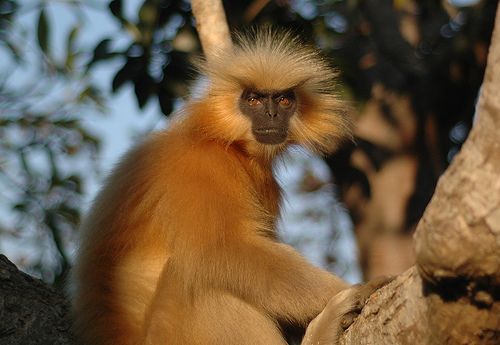
India of course has well over 1 billion human inhabitants. Tenancy of the subcontinent, however, is shared with another primate: the gray langur. In our recent trips we saw many langurs – one dashed across the road while we were driving to Ajanta so fast we could barely see. The fellow above we saw resting in shade at Daulatabad Fort. At Ajanta families of langurs rested in trees:
At Ellora the langurs were well habituated to people. In the parking lot a troop of them begged food … the langurs were like curious children, picking kernels of popcorn one at a time from outstretched hands. However getting close to these animals is not a good idea. Some carry rabies, but more generally these langurs are smart and have ways other than begging to get food from people. There are many stories posted online, like this, about langurs attacking in groups to divest people of grocery bags – pretty much anything carrying eatables. A colleague in my office related a story about langurs collaborating to steal a lady’s purse: one langur begged food, and when the lady offered, its confederate snatched the purse and immediately the first one began attacking the lady to cover the other’s escape.
These monkeys have an important place in Hindu mythology. The statue below is in Gujarat:
This is Hanuman, King of Monkeys and ally of Lord Rama in his fight against Ravana. He is holding his weapon, the gada. While the gada looks unwieldy, it was no problem for Hanuman; the monkey king was so strong that one time, when asked to retrieve a certain herb growing on a mountain but unsure of exactly which plant to pick, he picked up the whole mountain and brought that back. The ancient stories of Hanuman were the inspiration for Sun Wukong, the monkey king hero of Journey to the West.
Part of Hanuman’s story involves the gray langurs. The story is told in different ways, but the short form is this: Being monkeys the langurs were his subjects, and Hanuman commanded they follow him into battle against Ravana. Ravana used fire against them and their hands and faces were burnt black, and their langur descendants today still show the marks of the battle with the evil Ravana.
Hanuman is revered by Hindus for his many excellent qualities: Courage, Strength, Intelligence, but above all his complete devotion to Lord Rama. Alas, today Hanuman’s langur subjects have a hard life. The golden langur in particular is endangered, with only about 1,000 individuals in all of India.
He was a Muslim warrior, both pious himself and utterly unaccepting of impious behavior in others, and a Mughal emperor who ruthlessly consolidated control over all of India but in the end, was unable to stem the erosion of his empire. His name: Aurangzeb. Though he died more than 300 years ago, his capital, Aurangabad, still faces assault today, from relentless hordes of tourists who come to look at his works and – while some may despair – mostly just take pictures.
It is nearly a month ago now that Kim, Morgan and I traveled to Aurangabad. I’ve already posted about Ajanta and Ellora Caves, and on the conditions of drought we saw on our journey. I wanted to close out the record on that visit with a bit about the city, a bit more about some about a few other visits we made and, of course, pictures.
Aurangabad is called the City of Gates; in our time there we passed by or through 3 or 4. Here is an example:
These gates in Aurangzeb’s time were all part of a system of walls that protected the city. Today the walls are mostly gone, but the gates remain.
In a way Aurangabad encapsulates the story of today’s India. Westerners who come here quickly learn that across the country there are cities with names ending in “-bad”: Aurangabad, Hyderabad, and Ahmedabad are some of the largest, but there are many smaller such named cities. Almost all of these places were either established or re-named by the Mughals, the Persian/Muslim conquerors of Aryan/Hindu India, who ruled the subcontinent from the early 16th century to the mid 18th. For nearly two centuries the Mughal Empire was the richest in the world, but the death of Emperor Aurangzeb in 1707 marked the beginning of a swift decline.
One of the key forces at play in the downfall of the Mughals was the Maratha hero Shivaji. Born to a warrior clan he was raised into the family trade of being a mercenary. But Shivaji evolved a vision of freedom for his people and, after his fame and skill as a warrior grew, he began to confront the armies of the Mughals. In 1674 he established an independent Maratha Kingdom which persisted until 1818 when it became subservient to what would become the British Raj. Shivaji is a legend in Maharashtra – the Mumbai airport is named after him and school children here learn his life from comics like these (a gift from a work colleague):
This page relates the story of how Shivaji went in disguise to attack the Mughal ruler of Pune and to reclaim his childhood home, the Lal Mahal. But in addition to being a fierce and crafty warrior, Shivaji was also apparently an enlightened ruler. The Marathas of his time were a clan of Hindu warriors, but Shivaji brought many Muslims into his ranks, both as generals and as ministers.
A place that brought us closer to the conflicts of those long-ago times was Daulatabad Fort:
Kim posted about Daulatabad a few weeks ago. Side-note: See how almost all the people shown above visiting the fort are non-Indian? How can you tell? Hats. Indians never wear hats. Americans, Germans, Koreans, Russians, French: We all wear hats. On the day of our visit we encountered two large parties: one of Germans, and another of (we think) Koreans. The hawkers at these sites who sell fake ancient coins and other spurious artifacts should just switch to hats.
The northern half of India is very rocky and mountainous. For all of recorded history here military rulers have created forts on the many hilltops that define the terrain, and Daulatabad is a typical example. From the foot of the hill to the palace at the summit is several hundred meters; in many places are sheer walls with the only path a single meter wide. The entire way up is guarded by places where defending soldiers could fire projectiles or attack unexpectedly. Finally, there are two moats which make the ascent even more unlikely. This picture was taken about half way up:
To us a very interesting view was the remaining fortress walls that can be seen once you reach the top:
Aurangzeb, like overlords of the Deccan for centuries before, possessed Daulatabad. In his time the walls shown here encompassed a fortress town of soldiers, artisans and peasants. These are humbler versions of the kind of walls that must have girdled Aurangabad itself.
While Daulatabad was not built by Aurangzeb, on the last day of our trip we went to see something he had built: the Bibi Ka Maqbara, known hereabouts as the “mini Taj Mahal” – shown in the lead photo of this post. Aurangzeb built this as a memorial to his first wife, Dilras Banu. Here is an example of the massive marble carvings you find on this monument:
This carving above the main entranceway was easily 40 feet high by 40 feet wide. This pierced screen is also of marble:
While there are many and impressive ornaments here, we found particular interest in this:
This green parrot living atop one of the towers was like a tiny emerald set in a giant tablet of alabaster.
We westerners often think of India through simple images: Gandhi, Mountbatten, Slumdog Millionaire, Raj from BBT. Now in my list of images I have Aurangzeb He was an emperor, for his time arguably the richest and most powerful in all the world. His works and achievements were some austere, some beautiful, and some grim, and in the end what was important to him was swept away by an irresistible tide. He himself seemed to perceive this, for he is reputed to have said on his deathbed:
"I came alone and I go as a stranger. I do not know who I am, nor what I have been doing."
Such was our visit to Aurangzeb’s domain, where the remnants of old India’s wars and grandeur stay side by side, while the new India ponders the old emperor’s last words … were they lament, warning, or both?
It’s a few weeks ago now that Kim, Morgan and myself journeyed to see the sights near to Aurangabad. I’ve already posted about Ajanta Caves and Ellora Caves; now I want to share a few more things we saw, especially about the climate and lives of average folks here in Maharashtra. It is a sad fact that times here for a great many people are very bad indeed.
The first place we came to, still part of Pune proper, was Wagholi, a very fast growing area to the north-west of town. This picture from the web is typical of the many in-progress developments we saw:
Whether it will ever finish or not, there’s no way of knowing; it seems everywhere we go here there are big buildings in perpetual 1/4-finished state.
One reason this area is growing so fast is simply because it is close in, only 13 kms or so from center of Pune, but still fairly empty. Another is because of the increase in manufacturing in this region. There is a lot of heavy industry here, including Mercedes-Benz and Volkswagen plants to the north of town. As we continued on the road going north-east we passed facilities of many global companies – P&G, LG, Whirlpool, Haier – as well as many Indian companies making, for example, auto-parts, stone & tiles, and plumbing fixtures. Chatting with Rupesh we asked what type of people were the workers at these plants. He said a great many came from outside Maharashtra, from Uttar Pradesh mostly. Entry-level laborers at these factories will earn around Rs. 9 – 10,000 per month – about $190.
Soon we came to the first of several toll gates we would pass on the way to Aurangabad:
We did not stop to see what difference there might be between accessing the First Aid Box and the Complaint Book.
30 kms or so outward from our flat the road became a 4-lane road – 2-lanes in each direction – of good condition, our speed reached 100 kph many times. It was here for the first time I think we were seeing the “real” Maharashtra. Pune is a big place and fairly modern. Yes, cows, goats, dogs and other animals abound, but any place with a Hard Rock Café has an immense amount in common with a Western city. Away from the city proper we fell into a rhythm of passing 10 kms or so of farms, then coming to a tiny village of tea-stalls and shops, then going on through another 10 kms of farms.
This pic from Google shows part of the way we took:
You can see a center of buildings down in the south-west of the picture, then as you go along the road an empty area of multi-colored fields, then another small nexus of buildings at the upper north-east of the picture. From Pune to Aurangabad we must have passed through 20 or so such small villages, and some larger towns as well.
Notice the many striped areas of differing colors? These are the different crops being cultivated in small plots. Probably the most prevalent crop is sugar-cane:
but we also saw corn, onions, cauliflower, cotton and more.
But you don’t really need a satellite picture to tell you that farms are small in India – little goods-carrier trucks with sacks of produce, usually with sandal-footed laborers riding on top – are ubiquitous here. These all carry the output of small farms to markets and depots in cities and towns. Because refrigerated transport is virtually unknown this produce is consumed typically within days of harvest. If you are eating in India, chances are good everything on your plate came from with a few 100 kms of where you are. This is a gigantic contrast with a state like Massachusetts in the US, which produces a lot of dairy, apples and cranberries, but gets virtually all other produce from Florida, Texas or California.
Another thing we saw on the road was the intense dryness of the land, like these fields:
or this dry river-bed:
Note the distant pools of water? In monsoon time this whole area will be a flowing river.
The monsoon is the arbiter of life here – it fills lakes (most artificially created by dams) and the water table that cities, villages and farms draw water from all through the year. The rains of June-Aug last year were especially sparse, and Maharashtra is now enduring the worst drought in decades. While many farmers are fleeing to cities, seeking work as laborers, some see no option but suicide – and there are stories of farm women and girls becoming sex-workers in cities like Mumbai.
A poor monsoon is only part of the reason for the drought. Clearly a great contributor is all the manufacturing I talked about at the start of this post. All factories use a lot of water. In addition to auto- and electrical-manufacturing, we passed paper mills and sugar refineries – two extremely water intensive operations. There does seem to be some local response happening, as I read here. The main technique is rainwater harvesting, where rain in monsoon time, through gutters and other catch methods is directed to cisterns, local ponds, or even straight to the water table. Another technique is the guli plug. The idea here is to create simple soil and rock dams in gullies to force more rainfall into the local water table:
I will post more when I know more. On our trip we saw many women working with water or carrying water, like this lady rinsing clothes in a trickle of water by the side of the road:
In the Aurangabad district we recently visited there are two world-heritage cave temple sites. One is the Ajanta Caves, which I wrote about a few days ago. Ajanta is a Buddhist site, constructed in the period from about 100 BCE to 450 CE. The second is the Ellora Caves, located about 30 kms from Aurangabad. Ellora was built between the 5th and 10th centuries CE, and its caves depict and celebrate Hindu, Jain and Buddhist beliefs. Wikipedia has an excellent writeup on Ellora. Another excellent site on the caves was created by ArtStor and the Indian Government; in this site is an interactive map that allows you to map photos to the layouts of the various caves.
So, since through the magic of the interwebs readers can find more and better facts than I could present, herewith then are my quick impressions of this incredible place. (For those who just want to page through our Ellora photos, they are available here on Dropbox.)
Ellora is spread out more than Ajanta, there are multiple clusters of caves and most people go from cluster-to-cluster by car. Seen from above the map of all the caves is like so:
We began our viewing with the far left cluster, then proceeded to the middle two, and finally ended on cave 16, which is a major complex in itself. (After cave 16, having spent the first half of the day climbing Daulatabad Fort, we were climbed- and caved-out.)
Our first cave was cave 32:
This cave is typical of Ellora in that it is mostly not roofed-over, but is a courtyard delved into the rock of the hillside. Inside is a sizeable elephant:
Cave 32 is one of the Jain caves. This and the other Jain caves feature many figures in seated meditation, just as in the most common depiction of Buddha; but these figures are not Buddha, they reflect the Jain discipline of meditation that in fact pre-dates Buddhism. Although Jainism is an austere faith, you quickly see these caves are more ambitious than most at Ajanta, making greater use of ornament, and combining Hindu symbols with symbols unique to Jainism. For example these two statues, at opposite sides of the cave 33 entrance, depict Sarvanubhuti (for Hindus, Kubera) and Ambika, god and goddess respectively of material prosperity:
From here we went to our next cluster, starting with cave 29:
This is a Hindu cave, one of the largest at Ellora. Close inside the entrance you find this wall-carving:
“Cave” is a tremendous understatement. Wikipedia says this excavation is twice the size of the Parthenon in Athens. The inner courtyard is easily 100 meters deep, plus that courtyard is ringed by multi-story galleries each 30 or more meters deep. Here’s a view from inside:
There’s many more photos I could post, and that in itself is a major message – all the Ellora caves are filled with detail and ornament, so much we could spend hours in any single one, let alone the whole complex of more than 30 caves.
How to contrast Ajanta and Ellora? Ajanta to me was intensely reverent – even with its many paintings and many carvings, it was a place clearly dedicated to the Way of Buddha, with every one of it’s halls proclaiming this function. The word I have for Ellora is exuberant. Being there, seeing the hundreds of silent stories proclaimed by its carvings of gods, goddesses, monks, elephants, demons and more, you feel the intensity of the 1,000-year-ago artisans and patrons who created this place. How else to explain just how tremendously overflowing the place is with detail and content? Another impression … When I see the easy familiarity the Indian visitors have with the overflowing iconography of the place I realize how much I don’t know the culture here. I look at a statue and I see an elephant, a woman, a multi-armed warrior, and that’s it. Indians by and large see much more, of this I am sure.
Since I concluded my Ajanta post with words of the Buddha, it seems fitting to close here by invoking one of the teachings of Jainism:
In truthfulness do reside self-restraint and all other virtues.
Just as the fish can live only in the sea, so can all other virtues reside in Truthfulness alone.
Mahavira (Bhagavati Aradhana, 842)
I am not sure if I will again visit Ajanta and Ellora – there is much to see in India and I only have two years, after all. However, for my USA friends and family, if you visit we could all do worse than a repeat trip to Aurangabad to see these unique works of the ancient world.
2,500 years ago, Siddhartha, a Hindu Prince, was born in Nepal. Dismayed to discover suffering, he tried to make sense of the world. After many excesses, and deprivations, and trials of character, he achieved the insight of the middle way whereby he freed himself from extremes and was able to see and be with clarity. Many followers sought his teachings and the one who was Siddhartha came to be called Gautama Buddha.
400 years after the time of Gautama his teaching has spread across the northern half of India. Then, as today, monks who follow this way practice meditation and reverent prayer as a discipline. At the northern edge of the Deccan Plateau, in the state that is today called Maharashtra, some followers of the Buddha came to rocky cliffs high up in isolated hills. There, in the solid basalt and granite of the cliff faces, they envision great halls where the distractions of the world cannot enter and prayers echo off of cool rock. With only the meanest of implements, they begin work, knowing it will fall to successor generations of monks to fully complete this vision. Local kings and princes sent many workmen, but the monks themselves – or so I believe – must have aided the construction. Surely this must have been another kind of meditation for them, as they wielded tools in silence, a single monk perhaps removing only a few feet of stone in an entire lifetime. Caves would be built here for five centuries to come, only to be forgotten for a 1,000 years or more …
Standing here in the 21st century, this is how the story of the Ajanta Caves seems to me. There are many examples of rock-cut or cave temples in India; back in January, our family visited the Karla Caves. Ajanta and Ellora (to be described in a separate post), in the district of Aurangabad, about 250 kms from Pune, are the preeminent examples of this rock-cut architecture. When Morgan had a 1-week school break we decided to use some of that time to view these ancient places. (The trip itself I shall have to post about as well.)
At the main compound of Ajanta there is a ticket booth, restaurant, a few shops, basic facilities. To reach the actual caves, there is a bit of a trek up stairs:
In addition to the many hawkers and supposed guides offering their goods and services, you can hire a sedan chair and bearers to carry you up. It is probably best for all involved that I declined to engage such a chair.
It takes perhaps 10 mins walk to reach the first cave. Here is the view when you reach the top:
There are 26 caves in all at Ajanta. The cliff describes a horseshoe shape with the oldest caves being at the middle of the horseshoe and newer caves to the right and left. The caves are of two types. The first type is a vihara prayer hall, where monks lived and prayed daily:
These halls are 30 or more meters across, 8 meters or more high, and surrounded by pillars; cut into the the walls are cells where monks would sleep. At the end of the hall is a shrine to Buddha:
These photos are so dark because flash photography is forbid in many of the caves. This is because these caves are painted, either to adorn the carvings or to present scenes important to Buddhist lore:
The second type of cave is the chaitya hall, a place purely for prayer with a stupa or shrine at the far end:
As Morgan in the foreground helpfully illustrates, the stupa is about 15-20 feet high.
This photo is cave 10, one of the oldest caves at Ajanta. Comparing older and newer caves you can see how stupas became more elaborate:
These are from, going left to right, cave 9, cave 10, cave 19 and cave 26. 9 and 10 were constructed approx. 100 BCE to 100 CE; 19 and 26 date from the 5th century CE.
All the open space you see here was created by human activity; these are not natural caves that were somehow enlarged, but bodies of solid rock where these large chambers were created. Cave 24 is an unfinished cave where you can see the process:
The workers would start the excavation at the ceiling, working down. Pillars were left in rough outline to be finished later. The actual removal of stone was accomplished by a combination of hammer/chisel, drill and a method of forcing dry wood fibers into cracks which were then wetted – the expansion of the fibers would crack the stone.
For me, Ajanta was a very affecting place. The early caves have a simplicity – even with their rich paintings – that is very humbling to contemplate. The later caves display more ornamentation, but still all is in devotion to Buddha:
Buddha said:
We are shaped by our thoughts; we become what we think. When the mind is pure, joy follows like a shadow that never leaves.
To visit these caves is to perceive at one time the suffering of their creation, but also the profound devotion of their achievement. The thoughts of those long-ago people and, as Buddha taught, what those people must have been, are there to be seen and touched at Ajanta.
My first elephant here in India, that is. We came upon this calm, apparently easy-going fellow driving in the area of Lakshmi Rd. here in Pune. Only as I was posting this picture did I notice the cruel implement leaning to the driver’s left.
I took this from our car. You can’t really see but this elephant passed to our left, even though you drive on the left in India. That is because here, elephant always has the right of way.