2023 in Reading

In the spirit of year-end stock-taking and new-year resolve, I thought I’d record some highlights of my reading from 2023. Non-fiction first …
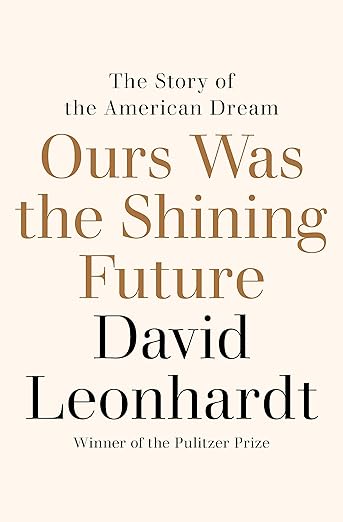 David Leonhardt is a long-time NYT editorial writer. Ours Was the Shining Future is a survey of American political history and progress through the 20th century to today, specifically from the standpoint of the “American dream”, that our children will have better lives than us; I think most people believe that is no longer a guaranteed outcome. The ultimate conclusion of the book is the rise of a “far left” or “academic left” in the 1960s undermined the more bread-and-butter agenda around jobs, education, and core social support that was set in place by the New Deal – seeking the perfect of eliminating discrimination and redistributing wealth was the enemy of the good of union jobs and accessible education. Whether you agree with his conclusions or not, the book is a valuable survey of how we got here.
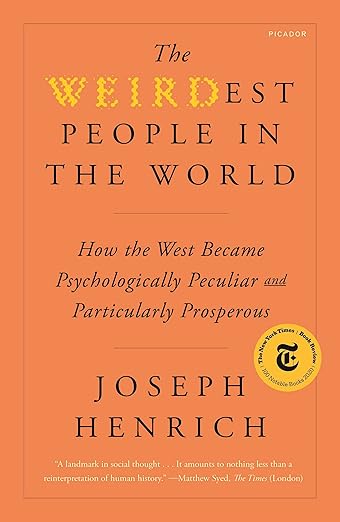 Joseph Henrich is an anthropologist who studies and writes on the intersection between culture and economics in the modern world. In this work WEIRD is an acronym for Western, Educated, Industrial, Rich and Democratic. The US, Great Britain, and Western Europe are the main examples of WEIRD societies. So, there’s no real question that these countries are more prosperous and powerful than countries in the so-called “global south” and, while the gap is closing, WEIRD countries collectively still are “ahead” of the countries of Asia. No question but that the “whys” here are complex, the history of colonialism itself makes these raw comparisons highly flawed.
Still I think Henrich’s argument is intriguing. The nutshell version: Dictates from the Catholic Church from the 1st millennium AD, forbidding cousin marriage and promoting primogeniture, undermined the historical family-tribal model of European society and opened the door for individualism. Imagine being a Gallic or Germanic tribesman, circa 500 AD. Your life would be determined by your family, and you marrying your cousin is what your family would choose – that strengthens the family because, unlike an outsider, your cousin can be trusted. Your overlord has probably sired children with multiple women, all of whom have a stake in the overlord’s domain. Now when the church forbids all that, you have to marry an outsider. Your family is less and less able to control your life, so you start making your own decisions on who to marry and how to work. You might leave the farm, move to Wittenberg and join a guild. Meanwhile the overlord has to invest in alliances, accommodatio and politics, he can no longer rely on a pre-made army of sons with their respective armies to fight for him. Finally, the book is not just supposition, there’s lots of data and current studies, my favorite of which is embodied in this question: “Generally speaking, would you say that most people can be trusted or that you need to be very careful in dealing with people?” Spoiler: 2/3rds or more people in WEIRD societies answer that people *can* be trusted; in non-WEIRD societies, its only 1/3rd. This higher level of trust lets us form partnerships , make contracts and do all sorts of cooperative things more easily and at a higher rate. Anyway, cool book, highly recommended.

Mark Z. Jacobson’s No Miracles Needed is an exhaustive review of how with wind, solar, and green hydrogen, we have all the tech we need to respond to climate change. Someone on the interwebs telling you we absolutely must have carbon capture or we’re all dead? This book is the encyclopedic answer to how that ain’t so. Also covered here, something new to me when I read it, is the ongoing cost of air pollution – every year 7 million people die due to direct effects of combustion pollution. A must-have reference for anyone who wants to discuss this issue at a detail level.
 Last in non-fiction, Ed Yong’s An Immense World. In keeping with its subject – how the five senses work for all manner of animals – this is a sensual, easy-flowing book. A concept Yong addresses early on is the flaws in thinking of senses in terms of “strength”. For example we generally assume and think that dogs’ sense of smell is “more powerful” than ours. This isn’t true as an all-encompassing statement; there are some odors dogs are unable to detect that humans sniff out pretty deftly. The discussion of pain as a sense was very thought provoking. Typically we think of sensing pain as requiring self-awareness; so fish, being obviously *not* self-aware, we conclude don’t feel pain. But fish have pain receptors similar to ours, and injuring a fish causes brain activity similar to our own. And injured fish exhibit behaviors consistent with “suffering”, like passing up food. The conclusion, pain for a fish is undoubtedly different than it is for us. That doesn’t mean it does not exist.
The book is a travelogue of animal sense, from mantis shrimp 12-color vision, to elephant infra-sounds, to octopus’ independently intelligent tentacles. Highly recommended.
Now on to fiction. I’ll start by touching on some less-than-favorites. First was Tough Guys Don’t Dance, by Norman Mailer. I picked this up in service of a goal to read important New England writers and this was on the list. And Mailer was famous for hanging out and writing in North Truro, where we have our beach place. In fact many of the settings in the book were familiar to me. Aside from that, book was junk – a more self-indulgent, joyless text you will never find. Every paragraph screamed, “I’m Norman Mailer so by definition this is great!” Yuck.
A goal in 2023 was to read more recent Fantasy and SF. To that end I got Babel, by R. F. Kuang. The story is about an alternate 19th century Oxford, where magic is real and is enacted by engraving text upon silver bars. The gimmick is the text is a phrase in a chosen language that embodies some idea or effect. Thus translators and linguists who understand the family trees of language are important. So the concept is clever and who doesn’t like Oxford? Babel has all the ingredients for classic fantasy of the cerebral sort in the vein of Jonathan Strange and Mr. Norrell. Alas, while the writing was workmanlike, I found the story dull and the characters flat, mostly whining about trivial misfortunes while they possess unique powers to actually do things that they never really use. And I found the ending pointlessly bleak.
Last in the not-so-favorite bin was The Long Way to a Small, Angry Planet (Wayfarers Book 1) by Becky Chambers. Speaking as an author (such as I am) this was a well-done book. It moved right along, the characters were differentiated and all had clever quirks and motivations, and the SF world-building was clearly thought out. But it was just not to my taste. It was kind of like a TV show – think Rodenberry’s Andromeda – with predictable characters and action. At the start a plucky heroine with a mysterious past becomes a crew member on a hyper-space bypass construction ship. The first forty pages are introductions to her new crew mates and its like the whole cast of Friends is there – there’s the brainy one, the grouchy one, the ditzy one, and so on. I am a bit amazed this won a Hugo; again its probably more about my taste than anything else.
Now on to my faves for fiction:
 Also part of my what’s-current-in-SF reading were A Memory Called Empire and A Desolation Called Peace (Teixcalaan Books 1 & 2) by Arkady Martine. I’m a big fan of culture as part of SF world building and Ms. Martine’s conception there is nuanced and completely credible. Galactic empires have existed since the Lensman series, if not before. Teixcalaan is an empire aware of its strength but conscious of its weaknesses. Its almost as if the leading characters sub-consciously sense the dangers of assuming a manifest destiny. A small example, the imperial police, who possess a group consciousness, are called The Sunlit. Sorry, but that is just plain cool.
The main characters are pretty good, exhibiting a gamut of moods and attitudes: funny, optimistic, inquisitive, disheartened, affectionate, and more. No one is an “epic” character, they are more ordinary people coping with extraordinary times, showing flashes of both strength and weakness in the process. For my part, this is a more credible Hugo winner.
 Dragon Chaser by Tim Stretton was a fun read. Stretton was one of the drivers of the Vance Integral Edition, the preserved complete works of Jack Vance (my copy is shown at the top of this post.) So Stretton is very much a Vance fan and a writer who can emulate Vance’ voice in new, enjoyable ways. Dragon Chaser uses Vancian themes of sailing, abstruse sports, and magic, combined with a hero that is competent, tending towards the ironic, but ultimately honorable. Spoiler: No one in this story has a tragic backstory, everyone is personally responsible for their own flaws and strengths. Highly recommended.
 Thus Was Adonis Murdered by Sarah Caudwell is a sort of book increasingly rare nowadays, for two reasons: First its a classic whudunit, being a story about a murder that is deductively solved by the detective; and second, it is an epistolary novel, i.e. the story is conveyed via letters read by the detective or to the detective.
These well-done structural elements are grand, but the book’s great achievement is the character of the detective, Oxford don Hilary Tamar. Hilary is witty, detached, precise, insightful, and polite less because of empathy to others but more because rudeness is inherently boorish. Last cool point: Hilary’s gender is never mentioned.
I read this before Babel – it must have set my bar for an Oxford novel higher than it otherwise would have been.
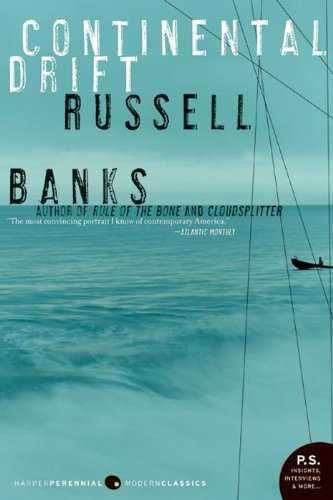 Last one to note today, Continental Drift by Russel Banks. This came from the same list of essential New England writers that gave me Mailer and Tough Guys Don’t Dance. And like Mailer, Banks is a “literary” author.
That’s the end of the similarities. Continental Drift is a heartbreaking book, the characters are flawed but hopeful, trapped by their pasts but constantly fleeing them – they’re ultimately doomed and we know it, but we have to read anyway. To all that Banks adds an almost magic scene-setting and sensuality, as the story moves from New Hampshire to Florida to further south in the Caribbean. The further south you go, the stronger voo doo becomes and the characters cannot escape its power.
I could not take a steady diet of this. But once a year or so, a book like this is a great reminder that writing needs to be about more than the three act grind with the Hollywood ending.
That’s all for now. Maybe next time I’ll share some updates on my own writing. Take care …